Augmented Reality in Our Life

License : CC0 1.0 Universal (Public Domain Dedication)

This work is dedicated to the public domain under CC0 1.0 Universal. To the extent possible under law, the author have waived all copyright and related rights to this work. You may copy, modify, distribute, and perform the work, even for commercial purposes, all without asking permission.

Finding an Old Document

Recently, while sorting through files to complete the XRAI hackathon report, I came across this old proposal from March 2017. It was for a concept focused on augmented reality, at a time when most people were only familiar with augmented reality through the game Pokémon GO, which had been released just eight months earlier.

Now, almost eight years later, it’s remarkable how many of the predictions have actually come true. Not because of any particular insight, but because the approach was from a Industrial designer’s perspective, focused on Human Needs rather than technological possibilities.

The proposal has a digital footprint that dates back to Mon, 27 Mar 2017, 08:03 in Bonn.
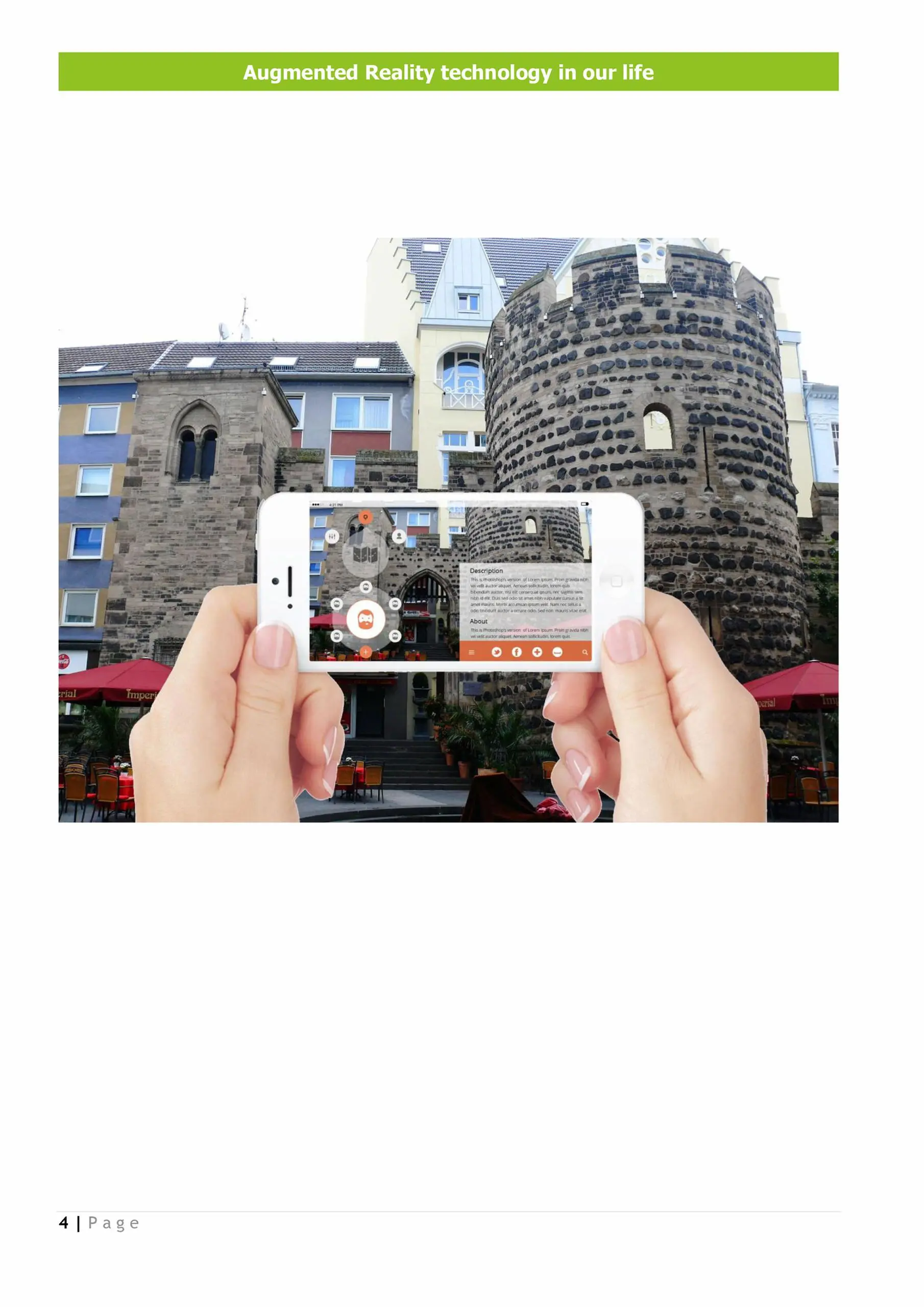
The Original Document

Augmented Reality Technology in Our Life

Author: H. Jawaheri

Date: March 2017

Location: Bonn, Germany

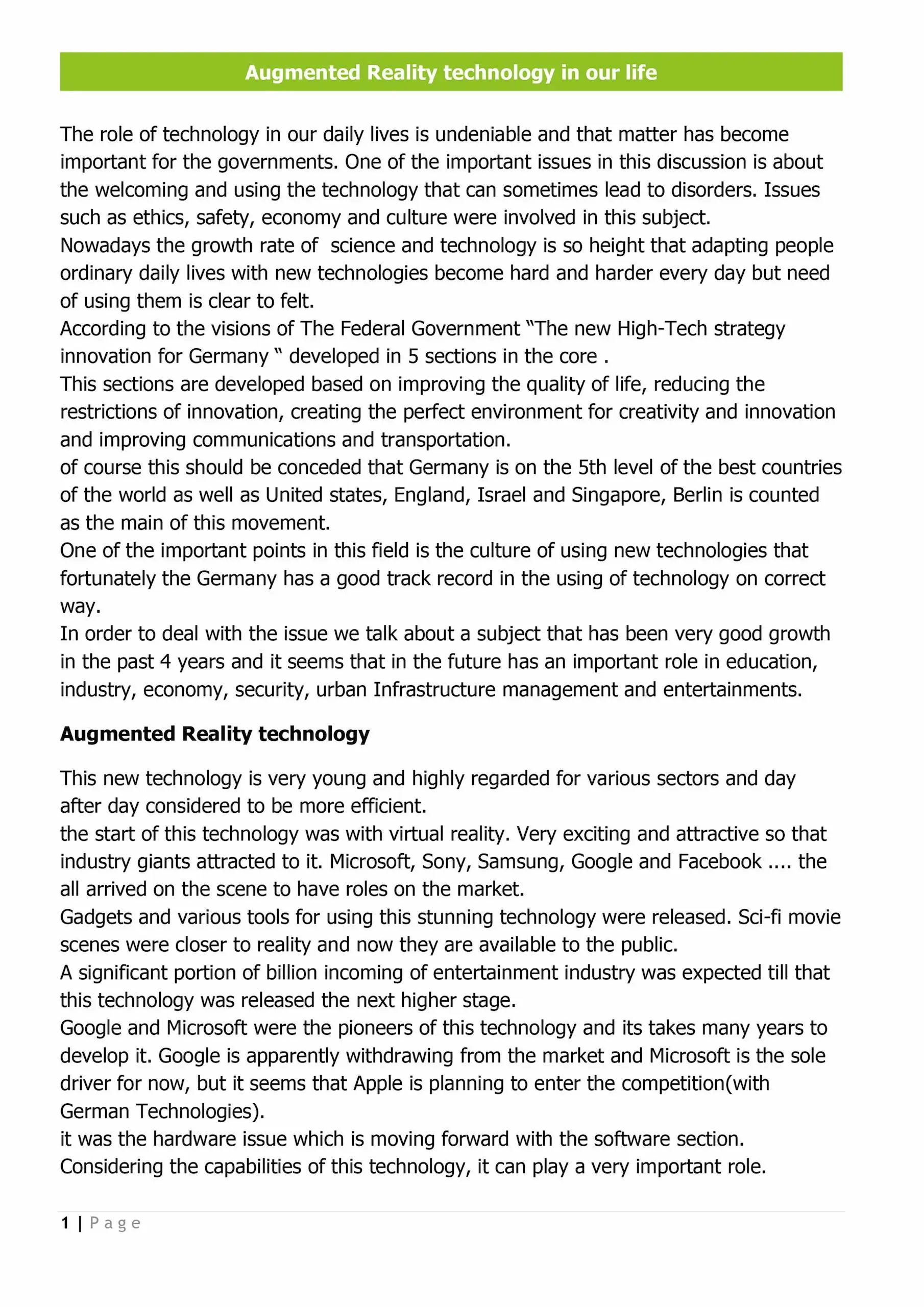
The Role of Technology in Our Daily Lives

The influence of technology in our daily lives is undeniable, and this has become a significant concern for governments. A key issue in this discussion is how to welcome and use technology, as this can sometimes lead to disorders. This topic involves issues such as ethics, safety, economics, and culture.

The rapid pace of scientific and technological growth makes it increasingly difficult for people to adapt their daily lives to new technologies, yet the necessity of using them is evident.
The Federal Government’s vision, “The new High-Tech strategy innovation for Germany” is structured around five core sections. These sections are designed to improve the quality of life, reduce innovation restrictions, create an ideal environment for creativity and innovation, and enhance communication and transportation.
Germany ranks as the 5th best country globally for technology, following the United States, England, Israel, and Singapore. Berlin is considered the central hub of this movement. Fortunately, Germany has a strong record of using technology correctly.

Augmented Reality Technology

Augmented Reality (AR) is a young technology with significant potential. It has shown remarkable growth over the past four years and is expected to play a crucial role in education, industry, economy, security, urban infrastructure management, and entertainment in the future.

The technology began with virtual reality, which attracted major industry players like Microsoft, Sony, Samsung, Google, and Facebook.
Gadgets and tools for using this technology have been released, bringing scenes from sci-fi movies closer to reality for the public. The release of this technology was anticipated to contribute a substantial portion of the entertainment industry’s billion-dollar revenue.

Google and Microsoft were the initial pioneers, spending many years on its development. Google is reportedly withdrawing from the market, leaving Microsoft as the current primary driver. However, Apple is rumored to be planning its entry into the competition, potentially with German technologies.

The software side of this technology has progressed well in the last two years, demonstrating its capacity to integrate into social and cultural spheres. In Germany, several companies are working in this field. Providing services to the industrial sector is the most significant activity, although some companies are also active in entertainment and games, and some startups have failed.

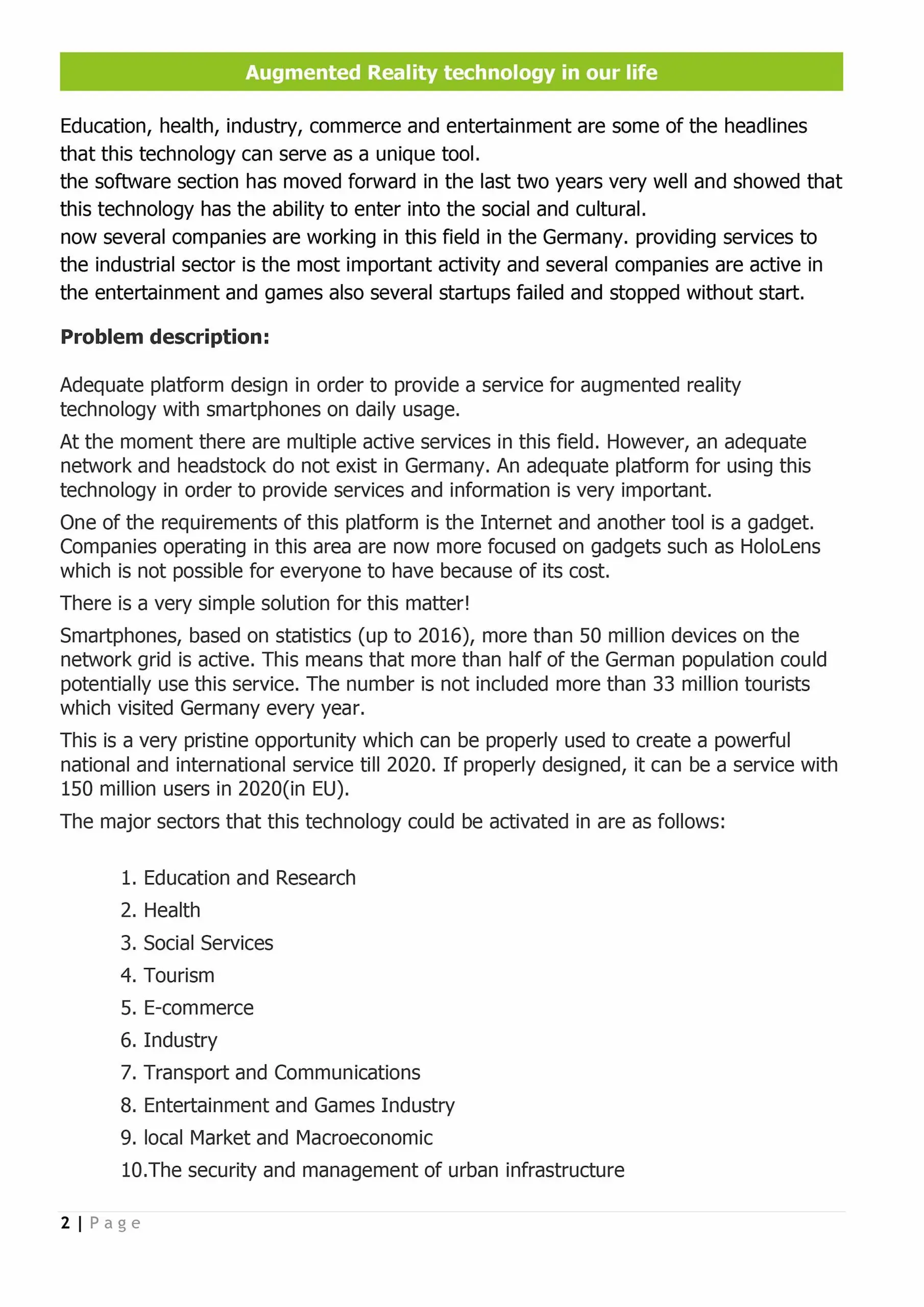
Problem Description

There is a need for a suitable platform design to provide Augmented Reality services for daily use with smartphones. While multiple services exist, an adequate network and headstock are currently absent in Germany. A proper platform is crucial for providing services and information using this technology.

The platform requires an internet connection and a gadget. Many companies are concentrating on expensive gadgets like the HoloLens, which are not affordable for everyone. A simple solution is to use smartphones.
According to 2016 statistics, over 50 million active devices are on the network grid in Germany, meaning more than half of the German population could potentially use such a service. This number does not include the over 33 million tourists who visit Germany annually. This represents a significant opportunity to create a powerful national and international service by 2020, potentially reaching 150 million users in the EU  if designed correctly.

The major sectors where this technology could be implemented include:

  • Education and Research
  • Health
  • Social Services
  • Tourism
  • E-commerce
  • Industry
  • Transport and Communications
  • Entertainment and Games Industry
  • Local Market and Macroeconomics
  • Security and Management of Urban Infrastructure

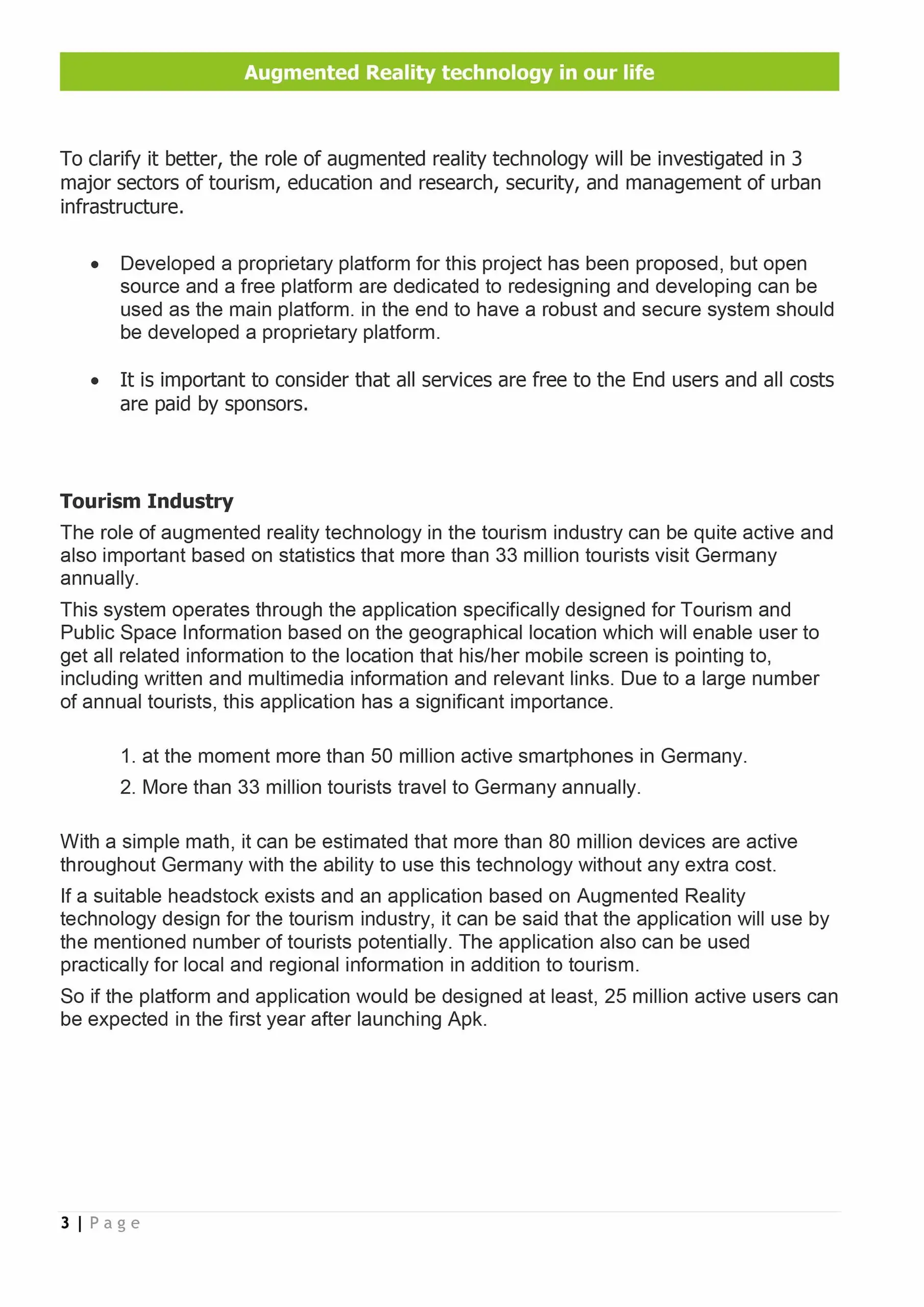
To better illustrate its role, the document will focus on three key sectors: Tourism, education and research, and security and urban infrastructure management.
A proprietary platform has been suggested, but a free, open-source platform could be used as the main platform, with redesign and development. Ultimately, a robust and secure system would require a proprietary platform. All services should be free for end-users, with costs covered by sponsors.

Tourism Industry

Augmented Reality can play an active and important role in the tourism industry, especially given that more than 33 million tourists visit Germany each year.

A dedicated application could be designed for tourism and public space information based on geographical location. This would allow users to point their mobile screens at a location and receive relevant written, multimedia information, and links. The large number of annual tourists makes this application highly important.

  • Over 50 million active smartphones are in Germany.
  • More than 33 million tourists visit Germany annually.

Simple calculations show that over 80 million devices in Germany could use this technology without extra cost. If a suitable headstock and an AR application for tourism were created, the application could be used by a large number of tourists.
The application could also provide local and regional information. It is estimated that a properly designed platform and application could attract at least 25 million active users in the first year after launch after launching Apk.

Augmented Reality Technologie in unserem Leben

Autor: H. Jawaheri

Datum: März 2017

Ort: Bonn, Deutschland

Die Rolle der Technologie in unserem täglichen Leben

Der Einfluss der Technologie in unserem täglichen Leben ist unbestreitbar, und dies ist zu einem bedeutenden Anliegen für Regierungen geworden. Ein zentrales Thema in dieser Diskussion ist, wie wir Technologie willkommen heißen und nutzen können, da dies manchmal zu Störungen führen kann. Dieses Thema umfasst Aspekte wie Ethik, Sicherheit, Wirtschaft und Kultur.

Das rasante Tempo des wissenschaftlichen und technologischen Wachstums macht es für Menschen zunehmend schwierig, ihr tägliches Leben an neue Technologien anzupassen, dennoch ist die Notwendigkeit ihrer Nutzung offensichtlich.

Die Vision der Bundesregierung, “Die neue Hightech-Strategie Innovation für Deutschland”, ist um fünf Kernbereiche strukturiert. Diese Bereiche sind darauf ausgelegt, die Lebensqualität zu verbessern, Innovationsbeschränkungen zu reduzieren, ein ideales Umfeld für Kreativität und Innovation zu schaffen und Kommunikation und Transport zu verbessern.

Deutschland rangiert als das 5. beste Land weltweit für Technologie, nach den Vereinigten Staaten, England, Israel und Singapur. Berlin gilt als das zentrale Zentrum dieser Bewegung. Glücklicherweise hat Deutschland eine starke Erfolgsbilanz im korrekten Einsatz von Technologie.

Augmented Reality Technologie

Augmented Reality (AR) ist eine junge Technologie mit erheblichem Potenzial. Sie hat in den letzten vier Jahren ein bemerkenswertes Wachstum gezeigt und wird erwartet, in Zukunft eine entscheidende Rolle in Bildung, Industrie, Wirtschaft, Sicherheit, städtischer Infrastrukturverwaltung und Unterhaltung zu spielen.

Die Technologie begann mit virtueller Realität, die große Industrieakteure wie Microsoft, Sony, Samsung, Google und Facebook anzog. Geräte und Werkzeuge zur Nutzung dieser Technologie wurden veröffentlicht und brachten Szenen aus Science-Fiction-Filmen näher an die Realität für die Öffentlichkeit. Die Veröffentlichung dieser Technologie wurde erwartet, einen erheblichen Anteil der milliardenschweren Einnahmen der Unterhaltungsindustrie beizutragen.

Google und Microsoft waren die ersten Pioniere und verbrachten viele Jahre mit ihrer Entwicklung. Google zieht sich Berichten zufolge vom Markt zurück und lässt Microsoft als den aktuellen Haupttreiber zurück. Allerdings plant Apple Gerüchten zufolge seinen Eintritt in den Wettbewerb, möglicherweise mit deutschen Technologien.

Die Software-Seite dieser Technologie hat sich in den letzten zwei Jahren gut entwickelt und ihre Fähigkeit demonstriert, sich in soziale und kulturelle Bereiche zu integrieren. In Deutschland arbeiten mehrere Unternehmen in diesem Bereich. Die Bereitstellung von Dienstleistungen für den Industriesektor ist die bedeutendste Aktivität, obwohl einige Unternehmen auch in Unterhaltung und Spielen aktiv sind und einige Startups gescheitert sind.

Problembeschreibung

Es besteht ein Bedarf für ein geeignetes Plattform-Design, um Augmented Reality-Dienste für den täglichen Gebrauch mit Smartphones bereitzustellen. Während mehrere Dienste existieren, fehlen derzeit ein angemessenes Netzwerk und eine Grundausstattung in Deutschland. Eine ordnungsgemäße Plattform ist entscheidend für die Bereitstellung von Diensten und Informationen mit dieser Technologie.

Die Plattform erfordert eine Internetverbindung und ein Gerät. Viele Unternehmen konzentrieren sich auf teure Geräte wie die HoloLens, die nicht für jeden erschwinglich sind. Eine einfache Lösung ist die Verwendung von Smartphones.

Laut Statistiken von 2016 sind über 50 Millionen aktive Geräte im Netzwerk in Deutschland, was bedeutet, dass mehr als die Hälfte der deutschen Bevölkerung potenziell einen solchen Service nutzen könnte. Diese Zahl schließt die über 33 Millionen Touristen nicht ein, die Deutschland jährlich besuchen. Dies stellt eine bedeutende Gelegenheit dar, bis 2020 einen mächtigen nationalen und internationalen Service zu schaffen, der potenziell 150 Millionen Nutzer in der EU erreichen könnte, wenn richtig gestaltet.

Die Hauptsektoren, in denen diese Technologie implementiert werden könnte, umfassen:

  • Bildung und Forschung
  • Gesundheit
  • Soziale Dienste
  • Tourismus
  • E-Commerce
  • Industrie
  • Transport und Kommunikation
  • Unterhaltungs- und Spieleindustrie
  • Lokaler Markt und Makroökonomie
  • Sicherheit und Verwaltung städtischer Infrastruktur

Um ihre Rolle besser zu veranschaulichen, wird sich das Dokument auf drei Schlüsselsektoren konzentrieren: Tourismus, Bildung und Forschung sowie Sicherheit und städtische Infrastrukturverwaltung.

Eine proprietäre Plattform wurde vorgeschlagen, aber eine kostenlose, quelloffene Plattform könnte als Hauptplattform mit Neugestaltung und Entwicklung verwendet werden. Letztendlich würde ein robustes und sicheres System eine proprietäre Plattform erfordern. Alle Dienste sollten für Endnutzer kostenlos sein, wobei die Kosten von Sponsoren getragen werden.

Tourismusbranche

Augmented Reality kann eine aktive und wichtige Rolle in der Tourismusbranche spielen, insbesondere da mehr als 33 Millionen Touristen Deutschland jedes Jahr besuchen.

Eine dedizierte Anwendung könnte für Tourismus und öffentliche Rauminformationen basierend auf geografischer Lage entwickelt werden. Dies würde es Nutzern ermöglichen, ihre mobilen Bildschirme auf einen Ort zu richten und relevante schriftliche, multimediale Informationen und Links zu erhalten. Die große Anzahl jährlicher Touristen macht diese Anwendung sehr wichtig.

  • Über 50 Millionen aktive Smartphones sind in Deutschland.
  • Mehr als 33 Millionen Touristen besuchen Deutschland jährlich.

Einfache Berechnungen zeigen, dass über 80 Millionen Geräte in Deutschland diese Technologie ohne zusätzliche Kosten nutzen könnten. Wenn eine geeignete Grundausstattung und eine AR-Anwendung für den Tourismus erstellt würden, könnte die Anwendung von einer großen Anzahl von Touristen genutzt werden.

Die Anwendung könnte auch lokale und regionale Informationen bereitstellen. Es wird geschätzt, dass eine ordnungsgemäß gestaltete Plattform und Anwendung mindestens 25 Millionen aktive Nutzer im ersten Jahr nach der Markteinführung nach dem Start der Apk anziehen könnte.

Cooked up by NotebookLM :)

English

A 2017 AR Time Capsule

“The 2017 AR Vision How One Proposal Predicted Our Tech Future (and What It Missed)”.

Deutsch

AR Zeitkapsel aus 2017

„Die AR-Vision 2017: Wie ein Vorschlag unsere technische Zukunft vorhersagte (und was er versäumte)“.

العربية

كبسولة زمنية للواقع المعزز

“الواقع المعزز بين رؤية 2017 و واقع 2025 الدروس المستفادة وتحديات المستقبل”.

فارسی

کپسول زمان واقعیت افزوده ۲۰۱۷

“سفر به ۲۰۱۷ پیش بینی واقعیت افزوده و درس های طراحی انسان محور”.

What Was Visible Back Then

In 2017, while living in Bonn and working on various design projects, the augmented reality landscape was dominated by expensive hardware like Microsoft’s HoloLens. Most discussions focused on the impressive technical capabilities of these devices.

But from a Industrial designer’s perspective, different questions emerged:

  • What problems do people actually have that augmented reality can solve?
  • Who has the devices needed to access augmented reality?
  • What would real adoption look like?

Several opportunities seemed obvious:

  • Germany had over 50 million active smartphones.
  • The country welcomed over 33 million tourists annually.
  • There was no coherent platform to deliver AR experiences to either group.

The resulting proposal described how AR could integrate across ten different sectors  from tourism and education to healthcare and commerce.
The main insight was simple: instead of building for expensive new hardware, build for the devices people already carry.

The Concept

The Concept was to build an open-source, decentralized augmented reality platform for tourism where users could point their mobile phones at places and view information through object recognition and geolocation. This information could then be shared across multiple platforms.

Each city could have its own platform and database, with stories about famous places told by locals, tailored to the culture, customs, and traditions of that city, and then presented to tourists.

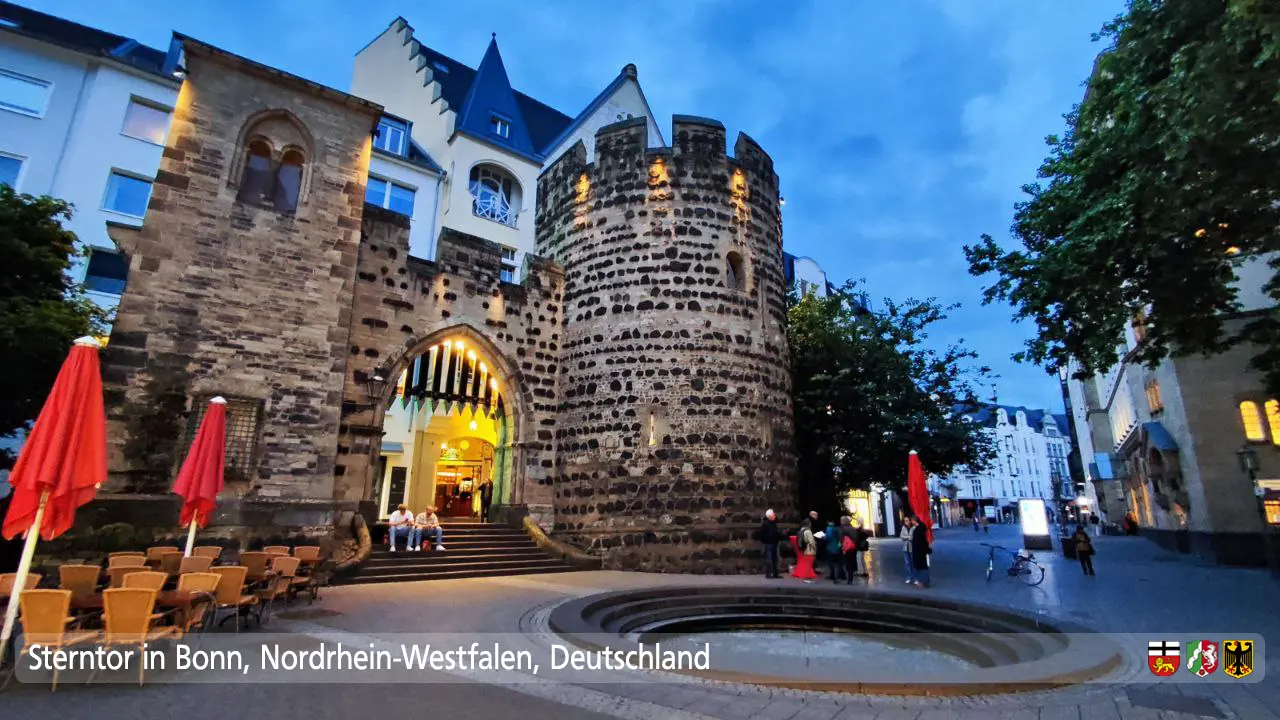
That same year, I took a photo of the Sterntor and created a visual prototype that assembled the UI elements on the photo.
The UI design is a copy of the ready-made design and I just collaged it.
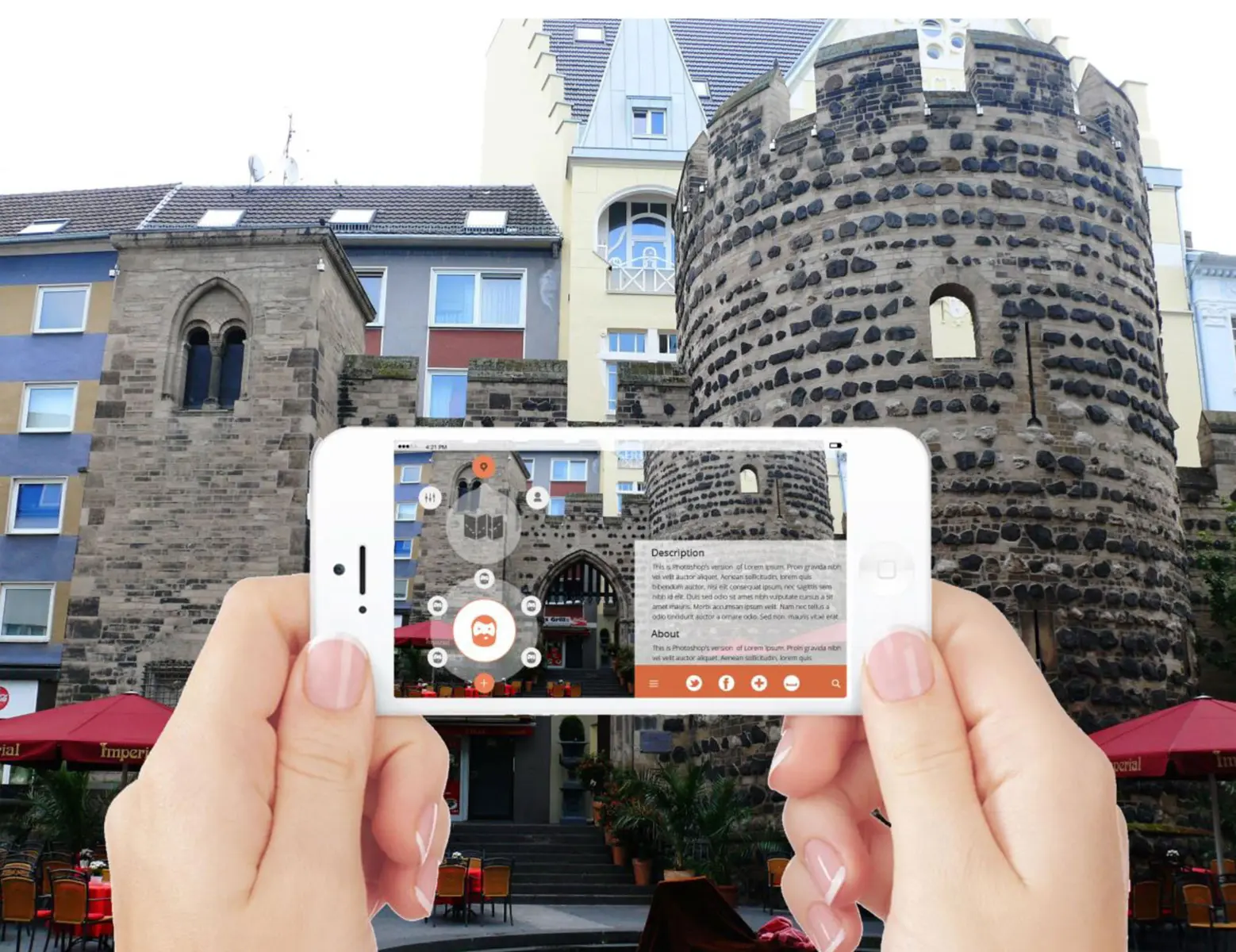

Hands holding a smartphone showing an augmented reality (AR) interface overlay on the Sterntor city gate in Bonn, with digital UI elements and descriptive text superimposed on the historical landmark.

Visual Prototype in 2017

Bonn Wiki Logo

Sterntor

The Sterntor, built around 1244 at the end of Sternstraße, is part of Bonn’s medieval fortifications. Bonn’s city fortifications included the Stockentor to the south, the Sterntor to the west, the Kölntor to the north, and the Rheinpforte to the east.
The Sterntor closed off Sternstraße until 1898. At that time, it still stood in its original location above Friedensplatz, then called Viehmarkt.
Read more about Sterntor on the Bonn Wiki.

Human-Centered approach

VDID Codex No.2 : For people
“Industrial designers have the human in mind. Also when considering many other requirements, the product design always fulfils the functional, psychological and sociocultural needs of people.”

VDID Codex:
“The VDID Code of Industrial Designers: Mission Statement and Ethical Values ​​of the Profession summarizes 12 guiding principles and identifies 10 focal points as challenges for the future.”
Read the VDID Codex “German Association of Industrial Designers” on the website.
www.vdid.de/verband/vdid-codex

VDID - Verband Deutscher Industrie Designer

The Feedback

The proposal was shared with several people and potential collaborators. The feedback was mixed. Some found it interesting but too broad. Others felt that AR was still too early for practical implementation. A few suggested focusing on a single use case rather than thinking about platform-level solutions.

In retrospect, their perspective makes sense. The proposal was quite comprehensive and perhaps even surprising. And in 2017, it was really early to think about the widespread adoption of AR in the market.

The proposal did not lead to the launch of a startup, but it became part of an ongoing exploration of how design thinking can help us understand technological change.

What Actually Happened

Here’s what’s interesting: reading this document today, it describes technologies and experiences that are now commonplace.

The proposal described travel apps where users could “point their mobile screen at a location and receive text, multimedia, and relevant links.” This essentially describes Google Lens and similar AR information services.

It predicted that AR would integrate across education, healthcare, retail, and entertainment simultaneously which is exactly what happened, rather than AR remaining limited to gaming or single-purpose apps.

The business model suggested services would be “free to end users, with costs covered by sponsors” which describes how most consumer AR experiences work today.

The timeline was reasonably accurate too. The prediction was for significant adoption within a few years, with AR features becoming standard on smartphones and mainstream apps between 2018 and 2020.

What Was Missed

Of course, there were some things that were not foreseen:

  • The platform landscape was assumed to be more open and competitive. Instead, Apple’s ARKit and Google’s ARCore created a dual monopoly that controls most AR experiences.
  • The privacy implications of the proposal were not addressed, an issue that has become particularly important in Europe with GDPR regulations affecting location-based AR services.
  • The impact of social media platforms on AR adoption was underestimated. Instagram and Snapchat filters became many people’s first lasting AR experience.
  • The COVID-19 pandemic accelerated certain applications (distance learning, virtual meetings) in ways that no one could have predicted.

The Timeline

This overview provides key developments and timelines for each topic in 2017, highlighting milestones, releases, and regulatory changes for each event.

GDPR & German Implementation Timeline 2017

  • EU Level
    • Already in effect:
      GDPR was adopted April 14, 2016; entered into force on May 24, 2016. Member states were preparing for applicability from May 25, 2018.
    • 10 January 2017:
      EU proposes the new ePrivacy Regulation, supporting and clarifying rules for electronic communications under GDPR.
  • Germany: National Legislative and Institutional Activity
    • January–February 2017:
      The German Federal Government (Bundesregierung) prepares and agrees on the draft for the new Bundesdatenschutzgesetz (BDSG-neu), to align national law and practice with the GDPR. Consultations begin with state governments and expert authorities such as the BfDI and state data protection commissioners, including the Berliner Beauftragte für Datenschutz und Informationsfreiheit.
    • March 2017:
      Expert hearings in the Bundestag (Federal Parliament) and within key ministries. State regulators, including the Berliner Beauftragte, provide statements and readiness advice for Berlin authorities and institutions.
    • 27 April 2017:
      Bundestag passes the DSAnpUG-EU (“Datenschutz-Anpassungs- und -Umsetzungsgesetz EU”), which implements the new BDSG and many specific GDPR provisions nationally.
    • May 2017:
      • 12 May: Bundesrat (Federal Council) approves the new BDSG.
      • Throughout May, coordination with regional (state) data protection authorities and finalization of national technical and supervisory details.
    • June 2017:
      30 June: The new Bundesdatenschutzgesetz is signed by the Bundespräsident and published in the Bundesgesetzblatt. State-level data protection officers, including the Berliner Beauftragte, begin intensive public information, guidance for local government, and awareness work for private sector compliance.
    • July 2017:
      5 July: Official promulgation of the BDSG-neu in the Bundesgesetzblatt. German authorities—including data protection commissioners in Berlin and other federal states—launch workshops, updated guidelines, and registers to help organizations implement GDPR requirements for the May 2018 deadline.

Throughout 2017
German supervisory authorities (BfDI in Bonn and state-level, e.g., Berlin) focus on information campaigns, consult state and city governments, and issue transition guidelines for GDPR compliance, emphasizing citizen rights, new obligations, and enforcement mechanisms.

Berlin institutions, with active participation of the BlnBDI (Berliner Beauftragte für Datenschutz und Informationsfreiheit) set up local frameworks for training, citizen inquiries, and consultation.

Civil society organizations and individuals have also been active in this regard during this period, which I will add to this timeline.

Mastodon in 2017

  • Mastodon launched publicly in October 2016, but gained momentum in early 2017, particularly in March and April.
  • Mastodon.social, the main instance, and other key servers experienced significant growth in April 2017 with new regional servers, most notably mstdn.jp in Japan, quickly attracting tens of thousands of users.
  • By August 2017, Mastodon’s global user base had surpassed 766,000, reaching 1 million by December 2017.
  • Notable technical updates in 2017 included more flexible web columns, push notifications, support for the ActivityPub protocol, and improved accessibility with alt text for attachments.

ANIMA RES in 2017

  • ANIMA RES, based in Bonn, Germany, specializes in 3D medical animation, AR, MR and VR applications with a focus on pharmaceutical and medical education.
    ANIMA RES gained global recognition in 2017 and has worked closely with major technology companies such as Apple, Microsoft and Google.

BMW in 2017

Apple ARKit:

  • Announced on June 5, 2017 at WWDC as part of iOS 11.
  • Released to developers in June 2017 as part of the iOS 11 and Xcode 9 beta.
  • First released to consumers with iOS 11 on September 19, 2017, enabling access to ARKit apps in the App Store.

Google ARCore:

  • Introduced by Google in August 2017, it provides augmented reality development tools for Android devices without special hardware.
  • The developer preview SDK was launched in August 2017, supporting Google Pixel and Samsung S8 smartphones on Android 7.0 and above.
  • The stable version 1.0 of ARCore was expected to be released in early 2018, but major development and public awareness began in the second half of 2017.

Time capsule?

In the winter of 2021, during the COVID-19 pandemic, I informally assisted Dr. Homayoun Golestaneh, Professor of Industrial Design at the University of Science and Technology (IUST), as a virtual assistant in his course “Designing for the Future.” In this course, three student groups presented projects on next-generation social networks, urban furniture, and future workplaces. The experience was both valuable and informative.

In my opinion, in the near future, most of the challenges will be about Data Ownership, Cybersecurity, and a Bottom-up Human-Centered Mindset.

Technology will be more accessible, reliable, invisible, and hopefully Human Dignity First.

If we want to see science fiction sooner, it might be interesting to watch the 2018 film “Anon,” directed by Andrew Niccol.

Why i Share This Now

Reading old predictions can sometimes feel a little embarrassing, but there is real value in revisiting them. It allows us to see how ideas evolve and to recognize which intuitions turn out to be accurate and which were misleading.

The purpose of sharing this is not to claim foresight or criticize those who overlooked AR’s potential back in 2017. Predicting the right timing for technology is genuinely difficult, and even well-informed people often disagree about when and how innovations will take off.

Instead, this reflection comes from curiosity about the relationship between Design Thinking and technology foresight.
The document suggests that Human-Centered approaches to understanding emerging technologies can complement the technical and market-driven analyses that usually dominate these discussions.

How different methodologies influence the way we anticipate technological change remains an open question.

For those working with emerging technologies, a few questions stand out:

  • What questions guide your analysis?
  • What assumptions shape your predictions?
  • How do you balance Human Needs with technical possibilities?

Hayder Jawaheri
August 2025
Bonn

Share This Story, Choose Your Platform!